
Patient lifts come in four main types defined by their mobility and mechanical application: mobile hoists, sit-to-stand lifts, bath lifts, and ceiling track systems. A buyer needs a specific mobility range before selecting a model, such as the 360-degree rotation of a mobile hoist versus the fixed path of a track. You should first measure the maximum weight of the person to be moved and compare it against the device’s weight capacity.
What are mobile hoists?
Mobile hoists are patient lifts designed to move a person between different locations, such as from a bed to a wheelchair or a chair. These devices use a frame and a lifting sling to support the user’s full weight while the unit is moved on wheels. They are for users who require significant assistance with every transition and may have limited ability to bear weight on their own.
How mobile hoists provide high mobility and full suspension
A mobile hoist provides the highest level of mobility among portable options because it can navigate through doorways and around furniture. It gives up the ability to provide a self-supported transition, as the user is fully suspended or supported by the sling. These models generally sit in a mid-to-high price band relative to other portable options due to the motor and frame requirements.
New users can learn the basics in our guide on how a patient lift works for daily care.
How checking turning radius ensures a mobile hoist fits doorways
Choosing a mobile hoist that lacks the necessary turning radius can result in a unit that cannot navigate through a standard 32-inch doorway. A buyer starts by identifying the narrowest path in the home, then checks the footprint of the hoist, and finally confirms the turning clearance. The result is a lift that can access every room in the house without requiring the removal of heavy furniture.
Where these choices show up in our reviews
Prices across these 3 run from $162.36 to $379.99; each one has a full review here.

What are sit-to-stand patient lifts?
Sit-to-stand lifts are patient lifts that provide mechanical assistance to help a user rise from a seated position to a standing position. These units are for individuals who have some lower-body strength but need help with the initial lift to avoid straining their joints or the caregiver. They do not provide full-body suspension like a mobile hoist.
Determining the correct dimensions is simple when you calculate the reach for patient lifts.
Why sit-to-stand lifts offer natural transitions and lower costs
A sit-to-stand lift offers a more natural transition for the user, which can improve independence and mobility outside of the bathroom. It gives up the ability to perform a full transfer to a different room or a different surface. These units typically sit in a lower price band than full-body mobile hoists because they lack the complex sling-attachment hardware.
What are bath lifts?
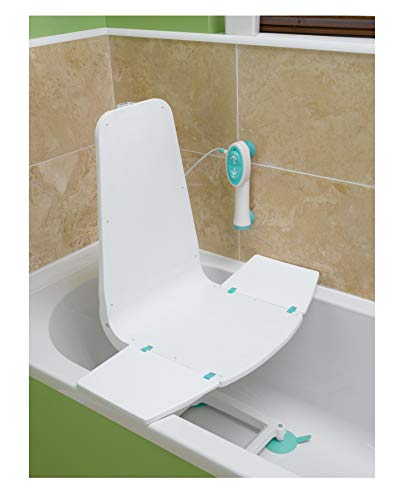
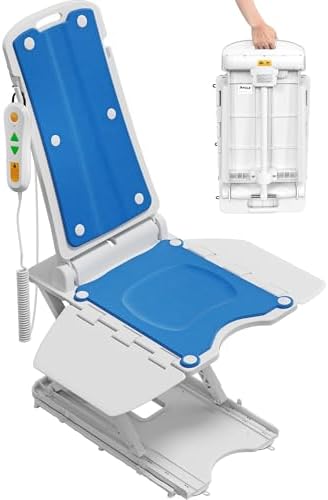
Bath lifts are patient lifts specifically designed for use within a bathtub or shower enclosure to assist with entry and exit. They provide a stable seat and a mechanical lift to move the user into a seated position. These are for users who need to maintain hygiene but cannot safely step over the tub wall.
You can see our data-driven analysis in our full Bellavita Dive Bath Lift review.
How bath lifts provide safety in high-risk bathroom environments
A bath lift provides a dedicated safety solution for a high-risk environment where a fall could be catastrophic. It gives up any mobility outside of the bathroom, as it is fixed to the tub or shower floor. These units often sit in a mid-range price band, depending on whether they are manual or powered.
How measuring tub dimensions ensures a proper bath lift fit
A user begins by measuring the depth and width of the tub, then selects a lift that fits those specific dimensions. They then install the lift and use it to safely lower into the water. The result is a bathroom that remains functional for a user who would otherwise be unable to bathe safely.
What are ceiling track systems?
Ceiling track systems are patient lifts that are mounted to a structural rail installed on the ceiling of a room. They move the user along a fixed path, often used in hospitals or specialized home bedrooms. These are for high-frequency, heavy-duty patient transfers where the user remains in one room.
Read our detailed evaluation of the Archimedes Bath Lift performance.
Why ceiling track systems offer stable lifting and high costs
Ceiling track systems provide the smoothest and most stable lifting experience because they are not subject to the floor-level friction of a mobile unit. They give up any mobility beyond the pre-installed rail. These systems sit in the highest price band because they require professional installation and structural engineering.
Ceiling track systems are the professional standard for high-frequency, heavy-duty patient transfers. In contrast, the mobile hoists on this page provide a weight capacity that allows for movement across different rooms, whereas a track system is limited to the space between the rails.
For a deep dive into the features, see our full Lumex Splash Lift review.
Comparison of patient lift types
| Type | Best-fit buyer | Main advantage | Main compromise |
|---|---|---|---|
| Mobile Hoist | Users needing room-to-room transfers | Full-body mobility | Requires sling use for every move |
| Sit-to-Stand | Users with some lower-body strength | Promotes independence | No full-body suspension |
| Bath Lift | Users needing assistance in the tub | Safe bathroom access | Limited to the bathroom |
| Ceiling Track | High-frequency, heavy-duty use | Maximum stability | Fixed path and high installation cost |
How to tell which patient lift type you need?
You need a mobile hoist if the user requires a transition between different rooms, such as moving from a bedroom to a living area. This is the correct choice if the user cannot bear enough weight to stand up independently or if they need to be moved into a wheelchair frequently.
You need a sit-to-stand lift if the user can bear some weight on their legs but struggles with the initial movement of standing up. If the goal is to help the user maintain their own mobility during the day, this type provides the necessary support without full suspension.
You need a bath lift if the primary safety concern is entering and exiting a bathtub or shower. If the user can move between rooms but cannot safely navigate the height of a tub wall, this is the appropriate solution for the bathroom.
We provide a comprehensive analysis in our full Bellavita Bath Lift review.
You need a ceiling track system if the user remains in one room for the majority of the day and requires frequent transfers between a bed and a chair. This is the choice when the user’s weight or the frequency of movement exceeds the practical limits of a portable unit.
Powered sit-to-stand lifts are the benchmark for mobility assistance outside of the bathing environment. If the user’s needs fall between a manual sit-to-stand and a full mobile hoist, you should evaluate whether the user can safely support their own weight during the “stand” portion of the movement.
Browse our other patient lift pages
- Best Waterproof Shower Chairs for Bathtubs
- Lightweight Patient Lifts for Easy Mobility Compared
- Choosing the Best Powered Sit-to-Stand Lift for Elderly Care
- The Bath Lifts That Work Best with a Remote Control
- Which Patient Lift Helps an Elderly Person into a Bathtub Safely?
- The Patient Lifts That Help People With Limited Mobility in the Bath
Bathroom Accessories World is reader-supported: some links on this page are affiliate links, and as an Amazon Associate Bathroom Accessories World earns from qualifying purchases at no extra cost to you. Learn more.