
Electric wheelchairs are mobility devices that use electric motors and batteries to move a user, with 107 of the 114 listings we screened stating they feature a foldable design. You need to identify the specific mechanical and electrical limits of a chair to ensure it handles your weight and your environment. You should measure your own body dimensions and your typical travel distance to find a chair that meets your specific requirements before you look at a specific model.
Electric Wheelchair Power and Range Specs
Motor power measures the electrical energy output of the drive system, and the median value across our screened listings is 500W. While a higher wattage can provide more torque for climbing, it does not automatically guarantee a higher top speed or a longer travel range. If you frequently navigate steep inclines or heavy carpets, a higher wattage rating provides the necessary force to prevent a motor stall on incline.
- Travel Range – This measures the distance the chair can move on a single full charge, with our screened listings showing a median of 15 miles.
- Dual Battery – This configuration allows for two power sources, which 32 of the 114 listings state they provide to extend the operational range.
- Lithium-ion vs. Lead-acid – This standard determines the trade-off between weight/charge cycles and cost/durability; Lithium-ion typically offers a higher power-to-weight ratio.
Where these choices show up in our reviews
Each of the 3 shown here has its own full review on this site; they run from $369.99 to $588.
New users can learn more in our guide on how electric wheelchairs work and function.
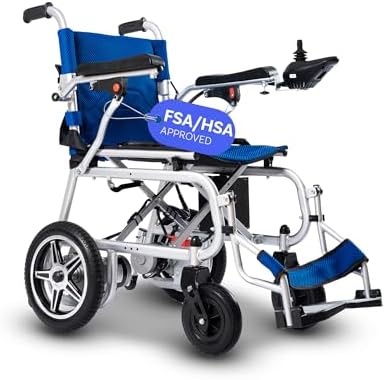


Electric Wheelchair Physical and Size Specs
Weight capacity measures the maximum load the frame and motor can safely support, with a median of 300 lbs among the listings we screened. This is a critical safety threshold; if the weight of the user and the equipment exceeds this number, it can lead to frame flex or structural fatigue. You should ensure your total weight, including any heavy storage bags or oxygen tanks, remains below the stated limit.
- Weight Capacity – This measures the maximum load the frame and motor can safely support; a higher number allows for more users or heavier accessories.
- Product Weight – This is the weight of the chair itself, with a median of 48 lbs; a lower weight makes the chair easier to transport in a vehicle.
- Ground Clearance – This dictates the ability to clear obstacles and uneven terrain; a higher number allows the chair to pass over larger bumps or curbs.
Electric Wheelchair Drive and Tire Specs
Tire type dictates the choice between off-road vibration dampening and maintenance-free use. Solid tires are common, with 23 of the 114 listings stating they use this type, while pneumatic tires are listed in 9 cases. You must choose based on whether you prioritize the smooth ride of air-filled tires or the “never-flat” reliability of solid options.
We provide a detailed breakdown in our full Midivente SLF30 review.
- Pneumatic vs. Solid tires – This choice determines the trade-off between off-road vibration dampening and maintenance-free use.
- Drive Configuration – This describes the layout of the motors, such as front-wheel drive or rear-wheel drive, which impacts indoor maneuverability and outdoor stability.
- Foldable Design – This describes a frame that can be collapsed for transport, a feature stated by 107 of the 114 listings we screened.
- Puncture-resistant – This refers to tires designed to withstand sharp objects; 3 of the 114 listings specifically state this for their tires.
Electric Wheelchair Accessories and Compatibility
Accessories are additional components you must choose to match the specific dimensions and power requirements of your chair. A replacement battery must match the voltage and capacity of the original unit to ensure it provides the correct travel range. You should check the seat width and depth of any seat cushion to ensure it fits within the frame’s dimensions without obstructing the joystick controller.
- Replacement Battery – This extends the operational range and lifespan of the chair; it must match the specific voltage and chemistry of the original.
- Seat Cushion – This provides pressure relief and postural support; it should be sized to fit the specific seat width of your chair.
- Storage Bag – This allows for transport of personal items; it must be compatible with the back of the chair or the footrest area.
- Joystick Controller – This determines the input sensitivity and ease of navigation; it must be positioned so you can reach it comfortably from your seated position.
Which terms are often confused?
Buyers often confuse motor power with travel range, but these measure different things. Motor power is the electrical energy output of the drive system, while travel range is the actual distance the chair can move on a single full charge. A chair with a high-power motor might still have a short travel range if the battery capacity is small.
You can see the technical specs in our full HR-DP-001 Carbon Wheelchair review.
How seat width differs from the overall width of a power chair
Another common point of confusion is seat width versus product width. Seat width measures the horizontal space available for the user to sit, whereas product width includes the wheels and frame. You must ensure the seat width is sufficient for your body, regardless of how wide the overall chair is.
Differences between the weight capacity and the empty weight of a wheelchair
Finally, do not confuse weight capacity with product weight. Weight capacity is the maximum load the chair can safely support, while product weight is how much the chair weighs when empty. A lightweight chair with a high weight capacity is often the most versatile for transport and daily use.
Browse our other electric wheelchair pages
Bathroom Accessories World is reader-supported: some links on this page are affiliate links, and as an Amazon Associate Bathroom Accessories World earns from qualifying purchases at no extra cost to you. Learn more.