
Electric wheelchairs come in three main types: lightweight foldable, standard foldable, and heavy duty. These categories are defined by the total weight of the chair, which determines how easily the device can be transported or maneuvered in tight spaces. You should decide on a type based on how often you need to move the chair between locations, as a chair that is difficult to transport may limit your mobility to a single room or building. Measure your required transport frequency; if you need to move the chair into a car or onto a plane weekly, a weight under 50 lbs is a standard target.
Electric Wheelchair Types Among the Listings We Screened
| Type | What sets it apart | Listings we screened | Price range | Median motor power |
|---|---|---|---|---|
| Lightweight Foldable | product weight up to 50 lbs | 47 | $379.99 to $3999 | 400W |
| Standard Foldable | product weight 50 to 100 lbs | 42 | $299 to $3490 | 500W |
| Heavy Duty | product weight 100 lbs and up | 1 | $769.99 | – |
Counted over the 114 listings this site screened; a listing that does not state the figure a type is defined by is not counted under any type.
Where these choices show up in our reviews
Prices across these 3 run from $369.99 to $699; each one has a full review here.

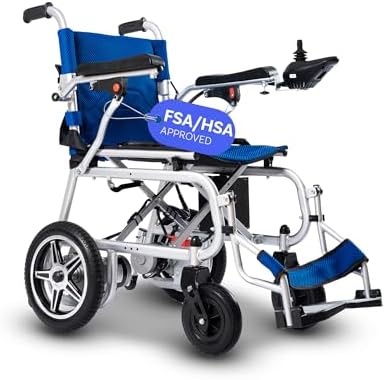

What defines a lightweight foldable electric wheelchair?
A lightweight foldable electric wheelchair is defined by a product weight of 50 lbs or less. These chairs are designed for users who require maximum portability without sacrificing the ability to operate the chair independently. Because of the reduced weight, these models often utilize smaller motors and compact battery configurations to maintain a slim profile.
Lightweight foldable electric wheelchairs offer portability with lower weight capacities
You should prioritize a lightweight foldable electric wheelchair if you frequently travel or need to store the chair in a small trunk. These models excel in transit because the frame is engineered to collapse into a compact footprint. However, the trade-off for this portability is often a shorter travel range or a lower weight capacity compared to larger models. The price for these models generally sits at the lower end of the market spectrum relative to heavy duty options.
What defines a standard foldable electric wheelchair?
A standard foldable electric wheelchair is defined by a product weight between 50 lbs and 100 lbs. This category serves as the middle ground for users who need a balance of indoor maneuverability and outdoor stability. These chairs offer more structural rigidity than the lightest models, allowing for a more stable ride over uneven surfaces like sidewalk cracks or grass.
Standard foldable electric wheelchairs provide stable bases for home use
You should choose a standard foldable electric wheelchair if you primarily use the chair within your home and for local errands. They offer a more substantial seat and a more stable base than lightweight models, which helps prevent the chair from feeling tippy during turns. While they are heavier to lift into a vehicle, they typically offer a more comfortable ride over longer distances. These models occupy the middle price band in the electric wheelchair market.
What defines a heavy duty electric wheelchair?
A heavy duty electric wheelchair is defined by a product weight of 100 lbs or more. These models are built with reinforced frames and high-torque motors to support users who require a higher weight capacity than standard models provide. Because the frame must withstand greater stress, these chairs are significantly larger and heavier.
Heavy duty electric wheelchairs support users exceeding 300 lbs
You should select a heavy duty electric wheelchair if your weight requirements exceed the standard 300 lbs threshold for safe operation. These chairs provide the necessary structural integrity to prevent frame flex or structural fatigue during use. The primary trade-off is that these units are very difficult to transport and often require a van or a lift to move between locations.
For those seeking specialized options, see the best power wheelchair for seniors.
Comparison of electric wheelchair types
| Electric Wheelchair Type | Best-fit Buyer | Main Advantage | Main Compromise |
|---|---|---|---|
| Lightweight Foldable | Frequent travelers | High portability | Lower weight capacity |
| Standard Foldable | Home and local users | Stability and comfort | Heavier to transport |
| Heavy Duty | High weight capacity users | Structural strength | Limited portability |
How do you know which electric wheelchair type fits your needs?
To determine which electric wheelchair type fits your needs, you must first identify your primary environment for use. If you plan to use the chair mostly indoors, a standard foldable electric wheelchair provides a stable base that handles turns predictably. If your daily routine involves moving between different buildings or into a vehicle, a lightweight foldable electric wheelchair is the practical choice.
Next, check your weight requirements against the structural limits of the chair. Selecting a chair with a lower weight capacity than your requirements can lead to frame flex or structural fatigue, which may damage the chair or compromise safety.
Motor power and portability trade-offs affect incline performance
Finally, consider the trade-off between motor power and portability. While a lightweight foldable electric wheelchair is easy to move, it may have a lower motor power rating than a heavy duty model. Choosing a chair that lacks the necessary torque for your environment can result in a motor stall on incline, where the chair stops moving because it cannot overcome the resistance of the slope.
How do these chairs compare to clinical benchmarks?
The electric wheelchairs on this page are often compared to Permobil or Quantum-Mobility chairs, which serve as the clinical-grade benchmarks for seating geometry and customizability. While the models listed here focus on portability and weight categories, the clinical benchmarks are known for highly specific seating configurations. Most of the models evaluated here do not offer the same level of customizability as these clinical benchmarks, but they provide a more accessible entry point for users who do not require a custom-fitted medical seating system.
Mid-wheel and rear-wheel drive configurations impact maneuverability and stability
Another point of comparison is the drive configuration, specifically mid-wheel drive vs. rear-wheel drive. Mid-wheel drive systems are the primary configuration choice for indoor maneuverability because the center of gravity is closer to the middle of the chair. Rear-wheel drive configurations are often preferred for outdoor stability because the weight is distributed over the back wheels. Most folding models prioritize a compact footprint, which may influence which drive configuration is available.
What happens if you choose the wrong wheelchair type?
Choosing a wheelchair that is too heavy for your transport needs can result in a return or the need to hire a transport service you did not plan for. If you choose a chair that is too light for your weight requirements, the frame may experience structural fatigue, leading to a costly repair or a total replacement of the chair. For example, if a user requires a high weight capacity but selects a standard model, the stress on the motor and frame can cause the chair to fail prematurely.
Balancing transport needs and motor power determines the best chair
A user first identifies their weight and transport needs, then selects a category based on those two numbers. They often find that a chair they liked in a showroom is difficult to lift into their car, leading them to reconsider the weight of the frame. They eventually end up with a chair that balances their ability to move the device with the power needed to move themselves.
When you are navigating a curb and the chair stops moving, it is often because the motor power is insufficient for the incline. This occurs when the motor lacks the torque to move the user’s weight upward, a situation that can be avoided by selecting a chair with a motor power rating that exceeds the requirements for your specific environment.
Related Electric Wheelchair buying guides
- All Terrain Electric Wheelchairs Compared
- The Folding Electric Wheelchairs That Work Best for Adults
- Certifications and Safety Standards for Electric Wheelchairs
- What Electric Wheelchairs Cost, and What Each Price Level Gets You
- Battery Type for Electric Wheelchairs: How to Choose Yours
- Seat Width for Electric Wheelchairs: How to Choose Yours
- Travel Range for Electric Wheelchairs: How Much You Actually Need
- Midivente SLF30 27LBS Foldable Electric Wheelchair
- 33lb Carbon Fiber Electric Wheelchair HR-DP-001
- K04 35.7lbs Lightweight Foldable Electric Wheelchair
- Zurcheel Lightweight Electric Wheelchair
Bathroom Accessories World is reader-supported: some links on this page are affiliate links, and as an Amazon Associate Bathroom Accessories World earns from qualifying purchases at no extra cost to you. Learn more.